It was one of those March days when the sun shines hot and the wind blows cold: when it is summer in the light, and winter in the shade.
~Charles Dickens
Eight Marches ago, on one of those biting Lion / Lamb days when the chill seeps to your bone, but every so often the wind relents and the sun warms your face, I put my spade, my shovel, my rake, and my hopes in the back of my Ranger and drive out to Malwyd.
It was rangy. Cabgrass and truculent hollies. Old azaleas. A grove of gnarled andromeda, noble and twisted.
But also, woodchuck holes and poison ivy, striped petunias and pachysandra, flagstone and old wrought iron. Good bones but rampant: an ancient estate. Nothing but rambling roses, possibilities, trepidation.
They let me place my shovel in that unforgiving clay, and it became a project that fed my soul.
But first we lay the garden hose along the edge of what will become the perennial garden, and adjust it relentlessly until we find a rhythm.
It is audacious: our proposed bed claims much of the lawn. Swift approval: with a nod sweet labor begins. Trenching the edge with a sturdy Amish shovel, I turn the turf to reveal writhing grubs and an impoverished clay, sickly and orange. We work it with mushroom soil and manure and peat and sand. Each thrust into the crabgrass my shovel slides over slippery, hard, angry clay. I turn it and churn it and hope for the best.
These little plugs we plant, from the wholesale nursery in Bucks County, seem so unsubstantial against the scope of the place. But work is underway and does not cease.
Some seasons are impossibly fecund and benevolent: soaking rains, nourishing sun, impossible bounty. Other seasons are pinched, dry, angry, and sparse. Skunks spray, firethorn taunts, there is the day my feet swell and burst the laces of my boots after an allergic reaction to a hornet swarm.
But, always, the labor.
Paths built. Slate cut. Trees felled.
We build a pond, a terrace, an ambling walkway through a grove of crimson maples.
At some point boundaries no longer contain our desire: the neighboring house is bought and razed, the garden doubles. We restore the orchard to where it once had been.
Days at Malwyd passed in a glorious rhythm: a neighboring carillon chimes almost forgotten hymns at just the right moment.
I lose myself in the work, I relish these golden afternoons
But, last March was the time.
This thing I created, this thing I nourished and savored, that also fed me, was left to fend for itself.
Enough of tending a garden that is not my own, last year I turned toward home, unsure what I would find.
All that glorious preparation, all that sweet and sunny labor well spent.
That place where I knew every leaf, and had seen every season, and had labored blissfully until the sun gave way to a luminous moon.
That place where I knew the toads that clamored so frantically on fecund spring days.
That place where crimson stars fell from Japanese maples onto English ivy.
My best work. I left its care to others, in humility and gratitude.
I sought new gardens to tend.
March is a raw month, elemental.
March is sun warmed soil and wind driven rain. March is biting chill, and hope that soars like a great blue heron, taking sudden flight. March is a month to take stock of paths that led to whatever vineyard you now tend, and a month to mourn just a little for that other path you did not take.
I used to, many Marches ago, think that every time you loved and lost, it left you diminished. But, as Marches go by, I have come to realize: you never lose if your labor is love. It may turn you inside out, but next time, if you are lucky, it will lead you to a fruitful vineyard. Love won't leave you diminished, but only open to the next right thing, grateful for the labors that led you to the place you now stand.
Each day the sun rises, and the sun also sets. But no two days are ever the same. Here, we muse about the urban landscape, things that grow, and the way the moon hovers on this night. Because no day will ever be just like this one again.
Wednesday, March 7, 2012
Sunday, March 4, 2012
Mrs. Taylor's Spectacles
![]() |
| The old red brick William and Margaretta Library Association, on Second Street, Cuyahoga Falls, Ohio, predating the white brick and marble Taylor Memorial Public Library of my youth. |
The normative institution of my formative years had a name that was pure torture for a small child who had trouble with his R's.
Taylor. Memorial. Public. Library.
It was bad enough that my name was Brian Gregory, but this place's name was nearly impossible to say. I didn't really know what any of those words meant, and had to practice a long time to say them in the right order.
The great thing about reading books was that I always said everything perfectly in my head. In real life L's and R's threw me for a loop, and made me a little ashamed.
But I loved that low marble counter on the children's end of the circulation desk, even though I worried because I was always bumping against whatever the generous maximum limit for the number of books you could check out was.
The best sound in the world happened after you handed your peach colored paper library card, with the metal plate, over to the library lady. She placed it in the machine, and then dropped the card from each book you had chosen from the stacks in. It made the most satisfying "chunk chunk" sound that you could ever imagine.
Years later, when they replaced it with a gun that slapped a price tag-like due date sticker on the book, I thought, wow, that seems disrespectful to the book somehow.
The library was close enough to walk to, and once I got old enough to cross Broad Boulevard on my own, I could ride my bike there of a summer day. In the era when air conditioning was still a bit of a luxury, I would then bask in a nearly perfect summer day. It was the next best thing to the forbidden swimming hole at the shale creek we called Trickling Springs, that dumped into the Cuyahoga beneath a hemlock grove, just past Mary Campbell's Cave.
In the summer, there were reading contests, involving a bingo card that made you read from every category in the stacks, and game pieces, which were toothpicks jabbed in a piece of Play Dough. You got to move a space on the game board for every book that you read. To this day, my brother and I still argue over who read more books. At some point we may have to call in Betsy Booth to officiate.
I loved everything about that library:
The stained glass window, Flora and Fauna of Ohio, which was real leaves and flowers, pressed between glass.
The sound the drawer on the card catalog (a heavy maple wood cabinet, presided over by a paper mache Pinochio) made, when you pulled it out, and thumbed through the cardstock files, looking for whatever new topic had piqued your interest.
The way they let me check out books from the adult section before I was officially old enough, after I had read through everything in the children's section.
The way checking out the LP of S.E. Hinton's The Outsiders suddenly made me feel like a really big kid, and like I understood those impossibly tall teenagers who towered over us with their 70's afros. Nothing gold can stay, Pony Boy.
The bronze statue of the fawn, at the bottom of the Story Time circle, where you could curl up with a new book when you realized you weren't quite ready to be a teenager.
I loved how my picture, Leopard in the Sun, pastel crayons on purple construction paper, made it into the All City Art Show, in the basement gallery. It felt like a big accomplishment for a kid from DeWitt, in a show normally dominated by the kids from Silver Lake and Richardson.
There was a metal sculpture by Mr. Simon, the art teacher from the high school. Read Indian flint arrowheads, pressed in glass, right at the Third Street entrance. A glass case full of ceramic figurines of Beatrix Potter characters. A Local History Room full of old maps and yearbooks. The price of admission: your peach-colored library card, and a signature on a page the reference librarian kept, stating you wuoldn't steal anything.
There was no end to the magic of this place, all the more when I realized, I could make a calligraphy masthead across the top of a piece of paper, typewrite my news stories below, Xerox it on the library machine for a nickel, and then sell it to my neighbors for a dime.
(Okay, when you factor in the labor costs, the Seventh Street Bugle-Messenger was never a cash cow, especially when you consider the time I spent, inspired by the Cleveland Press v. Plain Dealer rivalry, of coloring in my pictures with Crayola markers. The Press made a big push for being Cleveland's first color paper, and folded shortly thereafter. The Bugle-Messenger didn't last much longer.)
Somewhere near the front door, was a picture of the ivy covered old red brick original Taylor Library, and nearby, a glass case that displayed Mrs. Margaretta Taylor's spectacles.
I always liked that somehow, because it connected us to the person who founded this library, and reminded us that it didn't have to be here. This place existed because a very small woman, whose tiny wire frame glasses were in this case, wanted it to be here, and worked very hard to make it so.
Taylor Memorial Public Library. A difficult name for a small child who had difficulty with L's and R's to learn to say, but well worth the effort.
Lilacs in Tin Foil Vases: Thoughts on Home
![]() |
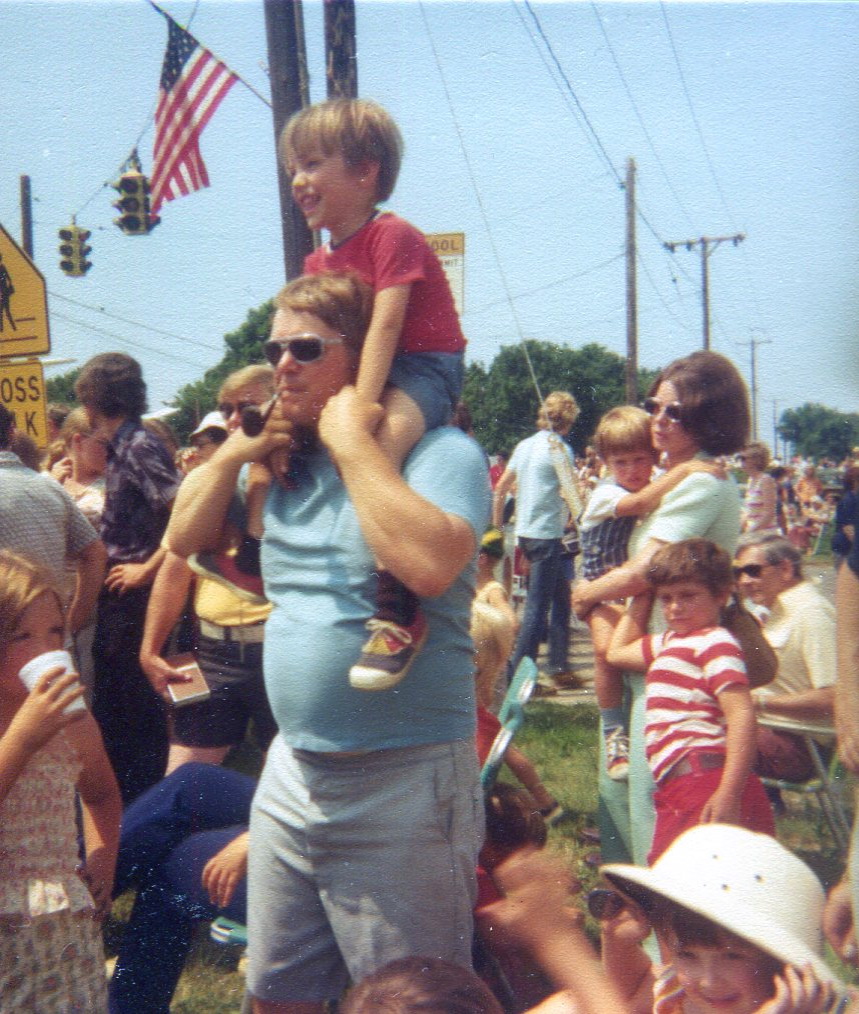
| On my Dad's shoulder's, Bicentennial Parade, 1976 |
In old family photographs, snapped on my Mom's Brownie camera, the house sits on raw soil, a fresh concrete walkway leading past bare cinder block foundation, to a hollow core front door.
![]() |
| 1971, a raw foundation on Seventh Street. |
A gnarled grapevine on a rusted wire fence hedged the backyard.
In a corner dark and mossy, a contorted dogwood, by far my favorite tree, crouched under a massive pear tree that would become our space ship. Under the pear tree was a place I loved to dig. Here, the soil was soft, moist, and dark, and you did not have to dig deep before you found treasure: shards of pottery, an old bent spoon, a rusty gate latch. Like the Bennetts' old plum tree or the twin massive cherry trees with shiny peeling bark in the Mays' front yard, or the old twisted lilac next to the brick farm house's back door, all along gravel-and-tar Seventh Street, and even under the soil, were remnants of what had been before.
On a Sunday afternoon thirty-five Mays ago, the day before the big parade, my Mom and sister cut bouquets from that ancient lilac. They took those little sprigs and for each one they crafted a little tin foil vase, and filled it with water, so they would not wilt while the Brownies held them in white gloved hand, down Broad Boulevard and all the way to Oakwood Cemetery, to be placed at the oldest soldiers' graves.
![]() |
| Oakwood Chapel, erected by the Ladies' Cemetery Association, 1883 |
![]() |
| James Gregory, in signature pith helmet, leads Pack 3186 down Broad Boulevard. |
![]() |
| A Cuyahoga Falls parade circa 1963, when the route took it down Front Street. |
The World War II vets are legion, in crisp VFW and American Legion caps and fezzes. The Korean vets, less numerous, still make a good showing. There are but a few Vietnam vets, scruffy and bearded, who get at first reluctant, and then appreciative, applause. The float where the vets enact the raising of the flag at Iwo Jima, as always, garners sustained applause.
A convertible approaches, courtesy of Wallace Oldsmobile on Front Street. A few men, perhaps the oldest I have ever seen, slouch in the back seat, in rumpled American Legion hats. They are the World War I veterans. My Dad, a prescient man, tells me, "Stand up, these men won't be with us much longer." We do, and I offer my best imitation of a Cub Scout salute.
![]() |
| The Broad Boulevard Memorial Strip, in a 1960s postcard view. |
These are the things that date you: one day you have great-grandparents, and grandparents, and parents, and then you do not. One day your esteemed teachers are still teaching, and then they retire, and then, they pass. One year there are World War I veterans marching in the parade, then just a few in a car, and then there are none.
The cartoon view of the seventies, of free love and hippies and day glow psychedelia, shrouds the more formal Midwestern first decade of my life.
We greeted the Bicentennial with unabashed red, white, and blue enthusiasm. We bought stiff leather "school shoes" from an elderly man with a shop down on Front Street, and kept rubber soled canvas "gym shoes" inside our desks, to be worn only for gym class. We learned to read from tattered Dick and Jane readers, with frayed red bindings, stamped with with the name of demolished Broad Street School, which Gordon M. DeWitt Elementary replaced. Sure, there was a house on Francis Avenue above Mary Campbell's Cave at the great gorge of the Cuyahoga, rumored to be inhabited by hippies, but it was still an era in which, on special occasions, little girls wore white gloves.
The things that date us: Memories of musty downtown department stores. Brownies in white gloves. World War I veterans, lapelled with red poppies, in remembrance of Flanders fields, riding in the parade:
In Flanders Fields the poppies blow
Between the crosses row on row,
That mark our place; and in the sky
The larks, still bravely singing, fly
Scarce heard amid the guns below.
We are the Dead. Short days ago
We lived, felt dawn, saw sunset glow,
Loved and were loved, and now we lie
In Flanders fields.
The day after reading of the death of Frank Buckles, the last Dough Boy, I sat bolt upright in bed, with a sudden need to remember lyrics to a song, sung over 20 years ago in A Capella Choir at Cuyahoga Falls High School:
Fair are the meadows,
Fairer still the woodlands,
Robed in the blooming garb of spring;
Jesus is fairer,
Jesus is purer,
Who makes the woeful heart to sing.
It is a very old hymn, of obscure German origin, which even as we sang it over twenty years ago, seemed old fashioned. It was a favorite, apparently of Miss Josephine Long, who established the choral music program at Falls High and was held in such esteem that her favorite hymn was still sung decades after her death, just as the A Capella choir still processed into the Christmas Vespers concert with candles, as she had done it, and applause was strictly forbidden, as she had deemed it to be.
The fields and the meadows of our memories. Fallow until we churn them, and then one thing connects to another. The day after I sat bolt upright and remembered those lyrics to Miss Long's favorite hymn, I was tending a garden I have nurtured some seven years. It is an old estate, surrounded by tolling bells: from several Episcopal churches, from our Lady of Lourdes, from the seminary of St. Charles Borromeo. And sometimes, from the Merion Tribute House, built to honor of those who fought The War To End All Wars. My day's labor is chimed by bells from many belfries, ancient hymns that I have known: my own perfect Eden.
![]() |
| A frieze on the Merion Tribute House honors Doughboys |
This past year I have been startled by encounters, seemingly random, that later drip with meaning.
It's not magic, it's just living long enough to see the patterns. With enough life experience, every thing that happens to you reminds you of something you've experienced before. And everywhere you look, remnants of what is no longer there. An old priest at St. Marys of the Barrens once told me, you reach a point where there is a ghost behind every tree.
![]() |
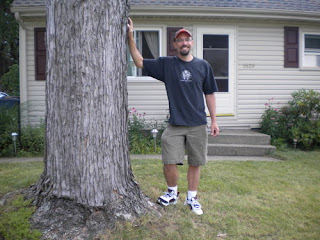
| 1971, I lean against a newly planted sapling. |
![]() |
| That tree and the author, 39 years later. |
Saturday, February 25, 2012
Under The Giant Hackberry Tree
The smell of snuffed candles. An organ postlude wafts through wooden church doors out over just-fallen snow. Under a giant hackberry tree, a lamb, someone’s tiny pony, hay bales, Mother and Child. Across the street, Charlie Boyd’s tinsel and lights, so garish by day, look just about perfect shrouded by snow. It is Christmas Eve 1976, and all of this happened in the one hour we were inside, as if on cue.
Celtis occidentalis, the common Hackberry, gets little respect. Its jagged tooth-edged leaves. Its tart mealy berries. Its lack of a colorful native name. Its wanton indiscretion about where it chooses to thrive.
Harbinger of nipple gall, powdery mildew, witch’s broom, jumping plant lice and a host of grisly arboreal ailments.
When horticulturalists grasp to sing its praise, its corky ridged and warty bark is what they settle on.
This unsung, wanton tree just happens to be the tree that marks the seasons of my life.
That simple living nativity under the hackberry’s winter bare branches, and the sudden magic of new fallen snow, is my first real memory of Christmas.
Decades later, its jagged irregular ovalish leaves provided May-perfect dappled sunlight for my sister’s wedding.
In high school, under a pelting February rain, a few days after a car full of classmates had careened down a steep ravine, Mr. Harding and Reverend Kimmel gently snaked the line of overflow mourners out from the hackberry’s inadequate shelter and into the breezeway, while more folding chairs were brought for them to the sanctuary. For the first time that I remember, that big yellow room did not seem sunny.
During Holy Week, a rough wooden cross is erected beneath its bud swollen branches, a cross that will be draped with a black cloth on Friday before we deck it with hyacinths and daffodils on Easter.
A silent presence through so many seasons of my life, I have always felt a certain kinship with this hackberry, perhaps because it bears a small bronze plaque declaring it the tallest tree of its kind in 1971, the year of my birth.
In the late seventies the hackberry was struck by lightening. Severely pruned in the aftermath, and rigged with wires, it has flourished in the decades I have been away.
For several years, when I would trek back to my old hometown and revisit haunts and dip my toes in the Cuyahoga’s waters, I would inevitably make my way the few blocks from the river to the public square that Judge Josiah Stow dedicated in 1830 for the free expression of divine worship. Ours was not to be a town dominated by a single spire, but in the square, a plot for the Methodist Society, a plot for the Episcopalians, and a plot for the Campbellites; on the green, a place for the Congregationalists; and just above the sublime ferny sandstone grottoes of the Glens, a church for the Catholics.
On my return visits, suddenly this tree, this silent, nondescript backdrop to my formative years, loomed large.
I began to notice it: I loved the shadow dance of floodlit branches on the building’s façade on a windy October night. Of a summer Sunday morning, I loved how its canopy of small jagged leaves dappled the eastern sun. The hackberry’s shade is not the gloom of a big leafed maple, or the solid cover of a mighty oak, but something enlivening and brisk and animated, a canopy that mottles but does not smother the sunlight.
I’ve never known the grace of elm trees, or the majesty of our native chestnuts, now vanished from the American landscape. This sturdy common hackberry is what I have to mark the decades of my life.
I love that any day now this sturdy survivor just might overtake the spire of the big church that was erected behind it. The old architect’s rendering of the new sanctuary, framed on a stairway in the basement, shows a circular driveway with fin tailed sedans where the hackberry stands, and a parking lot in the center of Judge Stow’s Church Square.
Sometimes we have the collective wisdom to not heed all of the experts’ recommendations. So the humble common hackberry tree continues to thrive, long after those postwar landboats moulder in an automotive grave.
I have almost completed my first set of seasons back under the old hackberry tree, my first as an adult in my old hometown. Not a Sunday goes by that I don’t pause to look up at its branches, to watch the sunlight filter through small serrated leaves, to watch snow coat the windward side of its jagged trunk, to watch small yellow leaves fall on an autumn lawn. And yes, to appreciate even its warty bark, ridged and corky.
In a few weeks buds will swell and leaves will unfurl again, sometime soon after we place daffodils on the old rugged cross beneath its boughs. As I walk out into the dappled sunlight, whatever hymn we have just sung will still be ringing in my head. I will look up at that canopy, composed of rough, imperfect, ovoid leaves, borne on this scaly warty trunk, a trunk rigged with lightening rods and cables, a tree susceptible to all sorts of ailments. A beautiful tree, all the more majestic in its imperfection.
I’ll look up at each of those sawtooth leaf blades, and I will think, these small imperfect leaves on this big tree are all the souls who set aside this square, who built these churches, who sang these songs.
In these songs we remember our faith, our scriptures, our theology. In this tree live all those saints, who sang our songs before us. Mr. Harding who held the front door open for you long after you had been away. Mrs. Underwood who wore a wide-brimmed hat. Mrs. Haught who made you a felt stocking in Preschool. Dr. Drake who signed your Bible in a left slanting script. Kevin who plunged into the ravine, Nancy whose smile lit the room, Steve who left us far too soon.
So many seasons under this old tree, shedding its leaves, dropping some branches, bearing small sweet fruit through the depth of winter after the showier berries are long gone. Then it buds out again, faithfully, sometime shortly after the dogwood trees.
Celtis occidentalis, the common Hackberry, gets little respect. Its jagged tooth-edged leaves. Its tart mealy berries. Its lack of a colorful native name. Its wanton indiscretion about where it chooses to thrive.
Harbinger of nipple gall, powdery mildew, witch’s broom, jumping plant lice and a host of grisly arboreal ailments.
When horticulturalists grasp to sing its praise, its corky ridged and warty bark is what they settle on.
This unsung, wanton tree just happens to be the tree that marks the seasons of my life.
That simple living nativity under the hackberry’s winter bare branches, and the sudden magic of new fallen snow, is my first real memory of Christmas.
Decades later, its jagged irregular ovalish leaves provided May-perfect dappled sunlight for my sister’s wedding.
In high school, under a pelting February rain, a few days after a car full of classmates had careened down a steep ravine, Mr. Harding and Reverend Kimmel gently snaked the line of overflow mourners out from the hackberry’s inadequate shelter and into the breezeway, while more folding chairs were brought for them to the sanctuary. For the first time that I remember, that big yellow room did not seem sunny.
During Holy Week, a rough wooden cross is erected beneath its bud swollen branches, a cross that will be draped with a black cloth on Friday before we deck it with hyacinths and daffodils on Easter.
A silent presence through so many seasons of my life, I have always felt a certain kinship with this hackberry, perhaps because it bears a small bronze plaque declaring it the tallest tree of its kind in 1971, the year of my birth.
![]() |
| Tall Tree Winner, 1971 |
For several years, when I would trek back to my old hometown and revisit haunts and dip my toes in the Cuyahoga’s waters, I would inevitably make my way the few blocks from the river to the public square that Judge Josiah Stow dedicated in 1830 for the free expression of divine worship. Ours was not to be a town dominated by a single spire, but in the square, a plot for the Methodist Society, a plot for the Episcopalians, and a plot for the Campbellites; on the green, a place for the Congregationalists; and just above the sublime ferny sandstone grottoes of the Glens, a church for the Catholics.
![]() |
| Disciples of Christ Church, Church Square, Cuyahoga Falls, Ohio |
I began to notice it: I loved the shadow dance of floodlit branches on the building’s façade on a windy October night. Of a summer Sunday morning, I loved how its canopy of small jagged leaves dappled the eastern sun. The hackberry’s shade is not the gloom of a big leafed maple, or the solid cover of a mighty oak, but something enlivening and brisk and animated, a canopy that mottles but does not smother the sunlight.
I’ve never known the grace of elm trees, or the majesty of our native chestnuts, now vanished from the American landscape. This sturdy common hackberry is what I have to mark the decades of my life.
I love that any day now this sturdy survivor just might overtake the spire of the big church that was erected behind it. The old architect’s rendering of the new sanctuary, framed on a stairway in the basement, shows a circular driveway with fin tailed sedans where the hackberry stands, and a parking lot in the center of Judge Stow’s Church Square.
Sometimes we have the collective wisdom to not heed all of the experts’ recommendations. So the humble common hackberry tree continues to thrive, long after those postwar landboats moulder in an automotive grave.
I have almost completed my first set of seasons back under the old hackberry tree, my first as an adult in my old hometown. Not a Sunday goes by that I don’t pause to look up at its branches, to watch the sunlight filter through small serrated leaves, to watch snow coat the windward side of its jagged trunk, to watch small yellow leaves fall on an autumn lawn. And yes, to appreciate even its warty bark, ridged and corky.
In a few weeks buds will swell and leaves will unfurl again, sometime soon after we place daffodils on the old rugged cross beneath its boughs. As I walk out into the dappled sunlight, whatever hymn we have just sung will still be ringing in my head. I will look up at that canopy, composed of rough, imperfect, ovoid leaves, borne on this scaly warty trunk, a trunk rigged with lightening rods and cables, a tree susceptible to all sorts of ailments. A beautiful tree, all the more majestic in its imperfection.
I’ll look up at each of those sawtooth leaf blades, and I will think, these small imperfect leaves on this big tree are all the souls who set aside this square, who built these churches, who sang these songs.
In these songs we remember our faith, our scriptures, our theology. In this tree live all those saints, who sang our songs before us. Mr. Harding who held the front door open for you long after you had been away. Mrs. Underwood who wore a wide-brimmed hat. Mrs. Haught who made you a felt stocking in Preschool. Dr. Drake who signed your Bible in a left slanting script. Kevin who plunged into the ravine, Nancy whose smile lit the room, Steve who left us far too soon.
![]() |
| Ancient gnarled Silver Maple on Church Square. |
Thursday, February 23, 2012
Mother of Presidents
I seek the back roads of Connecticut's old Western Reserve.
The places where you no longer need a map.
The places where a weather-battered general store sinks at an intersection where one road takes you to Burton, and the other, eventually, to Cleveland.
Freed from the platted irregularities of towns plunked down wherever there happened to be good and sufficient water to power a mill, or places where canal boats deposited their wares, or a places where someone came up with a better way to make matchsticks or mechanical harvesters or ball bearings, you find yourself in the pure geography of the American frontier.
You get away from the varicose population centers, snarled with curving streets and cul de sacs and outerbelts. You find yourself in Rootstown, or Atwater, or Palmyra, one of those perfect five-mile square townships with an eponymous village at its core, with a white frame congregational church on a patch of green, in a place where Connecticut veterans settled on plots granted to them for their suffering after the British burned coastal towns.
And so I find myself in Troy, Ohio, on a President's Day weekend when the grass is winter gold.
An Amish boy ties his single-horse cart to a post at the Marathon station.
A wood frame warehouse peels paint perceptibly.
Twin tire tracks transect a windswept graveyard.
I don't know anything about Troy, Ohio, but its little cemetery has the best collection of cast metal grave markers I have ever seen.
Cast metal grave markers remain crisp and legible, while neighboring stone markers weather to become blank slates. A flag has fallen to the grass next to a Civil War veteran's grave.
I am stalking a dead president. James A. Garfield, to be exact.
The last president born in a log cabin.
A president raised by a widowed mother on a hardscrabble farm in these very hills.
A President who drove canal boats, who studied at the Western Reserve Eclectic Institute, who roved on the Ohio frontier as a Disciples of Christ preacher, who returned to the Eclectic to teach classics, and within a year became its president.
A President who rose to the rank of Brigadeer General in the Civil War, who was eventually elected to this country's highest office.
Because I am in that part of the Western Reserve where the roads, except where they are Indian trails, run straight and true, I know if I head toward where the sun rises, I will find myself at Hiram, where the president taught school.
And so I do. A handsome brick Disciples of Christ church anchors one corner in Hiram, Ohio, while across a one-light intersection on a windswept little hillock, a little frame meeting house, like the one the president might have preached in, faces route 700.
A statue of the slain president rests on a sandstone pedestal. In Ohio our most important monuments always sit on a base of our native sandstone.
From there I settle on some winding roads through the Charin Valley, through the headwaters of the Cuyahoga. I know if I head due north, eventually I will find myself at Lake Erie.
And so on a February afternoon when winds whip clouds rapidly across a sun trying valiantly to shine down on brown grass, I find myself in a cemetery where angels with eroded faces gaze toward a brilliant firmament, and alabaster obelisks to barons assert themselves toward the sky.
On another hillock, a monument to a martyred president, this one an impossibly ornate sandstone pile crowned with gargoyles and friezes depicting a president's triumphant moments and agonizing death in sharp relief.
On this Presidents Day weekend I am the only one here at Cleveland's Lakeview Cemetery. Massive turquoise-painted wooden doors atop a grand staircase are splintered and locked.
I wander the hillsides past polychromatic stone "garden crypts," rendered all the more colorful by a season's lush moss carpet on sandstone walls. Statues of winged mercury, shrouded urns, allegorical maidens.
This grand place seems so far from those humble township centers.
I meander due south, down route 91, toward home, past the replica log cabin of Garfield's birth at Moreland Hills, and marvel at how sometimes the journeys you take, when you lose the map and just follow the roads, take you where you never intended, but needed to go.
These backroad rambles. These purposeful excuses to drift and tarry.
Certain intersections, where the boards are battered and weathered, where the graves are marked and tended, where the native sandstone is worn and mossy, can transport you to a revelatory place, where you see these hills where you were born and roved, not as a tired and spent place, but as a place where chestnut trees towered, and homesteads were forged, and classics were taught at windswept hillocks where geography decreed that roads would transect, in an unlikely woodland republic.
The places where you no longer need a map.
The places where a weather-battered general store sinks at an intersection where one road takes you to Burton, and the other, eventually, to Cleveland.
Freed from the platted irregularities of towns plunked down wherever there happened to be good and sufficient water to power a mill, or places where canal boats deposited their wares, or a places where someone came up with a better way to make matchsticks or mechanical harvesters or ball bearings, you find yourself in the pure geography of the American frontier.
You get away from the varicose population centers, snarled with curving streets and cul de sacs and outerbelts. You find yourself in Rootstown, or Atwater, or Palmyra, one of those perfect five-mile square townships with an eponymous village at its core, with a white frame congregational church on a patch of green, in a place where Connecticut veterans settled on plots granted to them for their suffering after the British burned coastal towns.
And so I find myself in Troy, Ohio, on a President's Day weekend when the grass is winter gold.
An Amish boy ties his single-horse cart to a post at the Marathon station.
A wood frame warehouse peels paint perceptibly.
Twin tire tracks transect a windswept graveyard.
I don't know anything about Troy, Ohio, but its little cemetery has the best collection of cast metal grave markers I have ever seen.
Cast metal grave markers remain crisp and legible, while neighboring stone markers weather to become blank slates. A flag has fallen to the grass next to a Civil War veteran's grave.
I am stalking a dead president. James A. Garfield, to be exact.
The last president born in a log cabin.
A president raised by a widowed mother on a hardscrabble farm in these very hills.
A President who drove canal boats, who studied at the Western Reserve Eclectic Institute, who roved on the Ohio frontier as a Disciples of Christ preacher, who returned to the Eclectic to teach classics, and within a year became its president.
A President who rose to the rank of Brigadeer General in the Civil War, who was eventually elected to this country's highest office.
Because I am in that part of the Western Reserve where the roads, except where they are Indian trails, run straight and true, I know if I head toward where the sun rises, I will find myself at Hiram, where the president taught school.
And so I do. A handsome brick Disciples of Christ church anchors one corner in Hiram, Ohio, while across a one-light intersection on a windswept little hillock, a little frame meeting house, like the one the president might have preached in, faces route 700.
A statue of the slain president rests on a sandstone pedestal. In Ohio our most important monuments always sit on a base of our native sandstone.
From there I settle on some winding roads through the Charin Valley, through the headwaters of the Cuyahoga. I know if I head due north, eventually I will find myself at Lake Erie.
And so on a February afternoon when winds whip clouds rapidly across a sun trying valiantly to shine down on brown grass, I find myself in a cemetery where angels with eroded faces gaze toward a brilliant firmament, and alabaster obelisks to barons assert themselves toward the sky.
On another hillock, a monument to a martyred president, this one an impossibly ornate sandstone pile crowned with gargoyles and friezes depicting a president's triumphant moments and agonizing death in sharp relief.
On this Presidents Day weekend I am the only one here at Cleveland's Lakeview Cemetery. Massive turquoise-painted wooden doors atop a grand staircase are splintered and locked.
I wander the hillsides past polychromatic stone "garden crypts," rendered all the more colorful by a season's lush moss carpet on sandstone walls. Statues of winged mercury, shrouded urns, allegorical maidens.
This grand place seems so far from those humble township centers.
I meander due south, down route 91, toward home, past the replica log cabin of Garfield's birth at Moreland Hills, and marvel at how sometimes the journeys you take, when you lose the map and just follow the roads, take you where you never intended, but needed to go.
These backroad rambles. These purposeful excuses to drift and tarry.
Certain intersections, where the boards are battered and weathered, where the graves are marked and tended, where the native sandstone is worn and mossy, can transport you to a revelatory place, where you see these hills where you were born and roved, not as a tired and spent place, but as a place where chestnut trees towered, and homesteads were forged, and classics were taught at windswept hillocks where geography decreed that roads would transect, in an unlikely woodland republic.
Saturday, February 11, 2012
A Vineyard in Winter
February's full moon sets in a pink morning sky over a vineyard that smells pungently of skunk.
January's placid, frigid solitude gives way to lengthening days and the discernible stirring of critters. There is no evidence that our innumerable groundhogs have roused themselves from their rocky warrens. (I suspect the famous Pennsylvania rodent is forcibly roused from his every February 2nd.) But the lingering odor of amorous skunks roving den to den is one sign change is afoot.
Robins, red breasted harbingers of spring, never really disappear in the winter, but are suddenly more prominent, pecking lasciviously at crab apples that remain, somehow, on a shrub near the crush house.
Canada geese leave web footed prints as they waddle through vineyard rows pecking for grubs and lingering grape seeds. Chased out of Eden and onto the frozen lake, they slide and struggle to gain enough speed to take flight to a neighboring, more hospitable lake.
Gina and Guiseppe, our resident mute swans, hunker near the moving waters at the inlet, then glide unperturbed and regal across the lake once the sun warms the waters, pausing periodically to arch graceful necks below the surface.
Normally they pay me no mind, but lately I find them gliding toward me, plucking bits of food off the lake's barnstone edge near wherever I happen to be, and dropping morsels below water to retrieve in one graceful motion. Unlike geese who graze on land, swans feed only off the lake's bottom, and this newfound interest in bits of food at the water's edge indicates they may have eaten the bottom clean.
Native Americans call this the Hunger Moon, and although February is a time when certain days bring bright sunshine and warm rays, it is also when last season's food begins to run out.
The swans anticipate the supplemental food we now place out for them each day, although Guiseppe has taken to swimming aggressively toward me with a fierce back paddle kick, with Gina trailing more languidly but still with considerable speed. They beat me across the lake to the feed bowl, and Guiseppe lunges toward me, indicating that once the feed is in the bowl, I am politely requested to get about my other business. While Gina plucks morsels from the bowl and drops them below water to retrieve, Guiseppe circles the bowl, puffed up and serious, and follows me to the other side of the lake to make sure I don't get a notion to come back too soon.
Our resident swans have also displayed a new found interest in twigs and branches on the lake bottom, indicating that perhaps sometime soon after the grape buds break, we will have cygnets gliding awkwardly behind their graceful parents, perhaps from a nest in the marshy area over near where the sharp-kneed heron roosts.
February is a time of anticipation and preparation. Last year's growth is pruned from hoarfrost crusted grapevines, then weighed to assess the vigor of last year's canopy, and determine the fruitfulness of this year's anticipated crop.
One sign after another. Newly pungent mornings. Tracks on new fallen snow. Lengthening days. The gathering of twigs and branches. The indiscernible swelling of buds.
Winter is not a dormant season, but a time of invisible preparation, a time of pregnant anticipation, a time of pink horizons at sunrise and days careening from sun to snow to ice to rain.
Some mornings after a wet snow and then a cold night, the vineyard sparkles like diamonds. Other mornings it is a symphony of brown grass and bare trunks, except where piercing sun suddenly illuminates startling green moss and lichen.
Winter in the vineyard is a brutal, beautiful season, when abundant future growth mingles with present deprivation, and when fierce winds sometimes give way to some of the year's best light.
January's placid, frigid solitude gives way to lengthening days and the discernible stirring of critters. There is no evidence that our innumerable groundhogs have roused themselves from their rocky warrens. (I suspect the famous Pennsylvania rodent is forcibly roused from his every February 2nd.) But the lingering odor of amorous skunks roving den to den is one sign change is afoot.
Robins, red breasted harbingers of spring, never really disappear in the winter, but are suddenly more prominent, pecking lasciviously at crab apples that remain, somehow, on a shrub near the crush house.
Canada geese leave web footed prints as they waddle through vineyard rows pecking for grubs and lingering grape seeds. Chased out of Eden and onto the frozen lake, they slide and struggle to gain enough speed to take flight to a neighboring, more hospitable lake.
Gina and Guiseppe, our resident mute swans, hunker near the moving waters at the inlet, then glide unperturbed and regal across the lake once the sun warms the waters, pausing periodically to arch graceful necks below the surface.
Normally they pay me no mind, but lately I find them gliding toward me, plucking bits of food off the lake's barnstone edge near wherever I happen to be, and dropping morsels below water to retrieve in one graceful motion. Unlike geese who graze on land, swans feed only off the lake's bottom, and this newfound interest in bits of food at the water's edge indicates they may have eaten the bottom clean.
Native Americans call this the Hunger Moon, and although February is a time when certain days bring bright sunshine and warm rays, it is also when last season's food begins to run out.
The swans anticipate the supplemental food we now place out for them each day, although Guiseppe has taken to swimming aggressively toward me with a fierce back paddle kick, with Gina trailing more languidly but still with considerable speed. They beat me across the lake to the feed bowl, and Guiseppe lunges toward me, indicating that once the feed is in the bowl, I am politely requested to get about my other business. While Gina plucks morsels from the bowl and drops them below water to retrieve, Guiseppe circles the bowl, puffed up and serious, and follows me to the other side of the lake to make sure I don't get a notion to come back too soon.
Our resident swans have also displayed a new found interest in twigs and branches on the lake bottom, indicating that perhaps sometime soon after the grape buds break, we will have cygnets gliding awkwardly behind their graceful parents, perhaps from a nest in the marshy area over near where the sharp-kneed heron roosts.
February is a time of anticipation and preparation. Last year's growth is pruned from hoarfrost crusted grapevines, then weighed to assess the vigor of last year's canopy, and determine the fruitfulness of this year's anticipated crop.
One sign after another. Newly pungent mornings. Tracks on new fallen snow. Lengthening days. The gathering of twigs and branches. The indiscernible swelling of buds.
Winter is not a dormant season, but a time of invisible preparation, a time of pregnant anticipation, a time of pink horizons at sunrise and days careening from sun to snow to ice to rain.
Some mornings after a wet snow and then a cold night, the vineyard sparkles like diamonds. Other mornings it is a symphony of brown grass and bare trunks, except where piercing sun suddenly illuminates startling green moss and lichen.
Winter in the vineyard is a brutal, beautiful season, when abundant future growth mingles with present deprivation, and when fierce winds sometimes give way to some of the year's best light.
Subscribe to:
Posts (Atom)