![]() |
| Me, far right, in the Gulf at Galveston, on the road to the Kerrville Folk Festival, sometime in the 90s. |
News of Pete Seeger’s death flowed from my car radio this frigid January morn, and I couldn’t shake the feeling that I had met him.
Each day the sun rises, and the sun also sets. But no two days are ever the same. Here, we muse about the urban landscape, things that grow, and the way the moon hovers on this night. Because no day will ever be just like this one again.
![]() |
| Me, far right, in the Gulf at Galveston, on the road to the Kerrville Folk Festival, sometime in the 90s. |
Certain older people of my youth knew where the good trees were.
For my grandmother in Southern Ohio, the hickory trees halfway up the slope of Mt. Pleasant merited a journey. Clutching brown paper Kroger bags we debark from the brick path behind her house, down the alley, up a crumbling and slightly mysterious set of steps at the base of the mount.
Excited, we cross the threshold to a well-trodden wood. Lover-carved tree boles. Dirt bike ruts. Spongy mushrooms or jack-in-the pulpit or doll eye plants draw our eye. Somewhere off the spider grid of dusty trail, we pass an enormous grapevine swing, then a grove of ancient mountain laurel, and finally, the hickories.
Strewn on the slope there, what seemed like impossible riches. Vague memories of stout trees with wide canopies, perfectly formed. But below them, on the ground, the reason for our journey. We stuff the best ones, filling our Kroger bags and begin the journey down and homeward, heavy laden with hickory nuts.
Two my third grade eyes, my teacher had something of the aspect of an old country school marm, with an olive green upright piano in the corner of her classroom, upon which every morning she pounded out "My Country tis of Thee."
She'd then have us take out a single sheet of ruled theme paper, and fold it in two, three, or four columns, depending on the day's lesson. We were then to write ARITHMETIC ("A Rat In Tom's House Might Eat the Ice Cream") across the top, in our best block letters.
The first week of third grade, she led us out to a tiny swale in the front yard of our newish buff-colored brick school, and had us gather walnuts from a twin set of trees that grew there where the avenue swerved and then led down to the great falls at High Bridge Glen.
Dim memories of a certain reverie when she spoke of these trees, a certain hush and awe that she shared with other older relatives of mine, when they spoke of walnut trees. Impossibly slow growing. Incredible timber value. The strength, the exquisite grain of its heartwood.
Tales of old dingy furniture possessing magic beneath cracked layers of ill considered paint. Tales of widows swindled by unscrupulous lumbermen, felling ancient sentinel dooryard trees and offering but a fraction of their worth.
The gathering of walnuts on the schoolyard the first week of third grade was not part of any lesson plan that I recall. We weren't studying ecology, or native trees of Ohio, or botany. We simply gathered walnuts because Mrs. Reynolds knew that they were there, and wanted us to, as well.
For an old country woman, it wouldn't do for a thing of value and potential nourishment to moulder on the schoolhouse lawn, or be ground and flung by mower blade.She taught us that beneath their acrid tangy outer husks, an acid green with stiff quills of hair, you would find the sweet oily kernels. Ripping them open, we'd feel a tinge on our hands, pungent black sap mildly burning and staining our skin.
She warned us not to keep them too long in our brown paper sacks, they might rot and be eaten by worms.
This September, standing next to an old hedgerow, a walnut tree I had never noticed plunked her fruit to the ground. Suddenly, that bracing astringent aroma, and with it, a flush of schoolhouse memories.
As one acid green tennis ball after another fell to the ground, from branches decked in frond-like serrated leaves just beginning to turn gold, I was taken back to a time when I knew where the sweetgums stood, and the horse chestnuts, and the myriad oak trees with their various acorns.
All of these treasures dropping from the sky, there for the plucking, if you were lucky enough to know certain older people, who knew where the good trees stood.
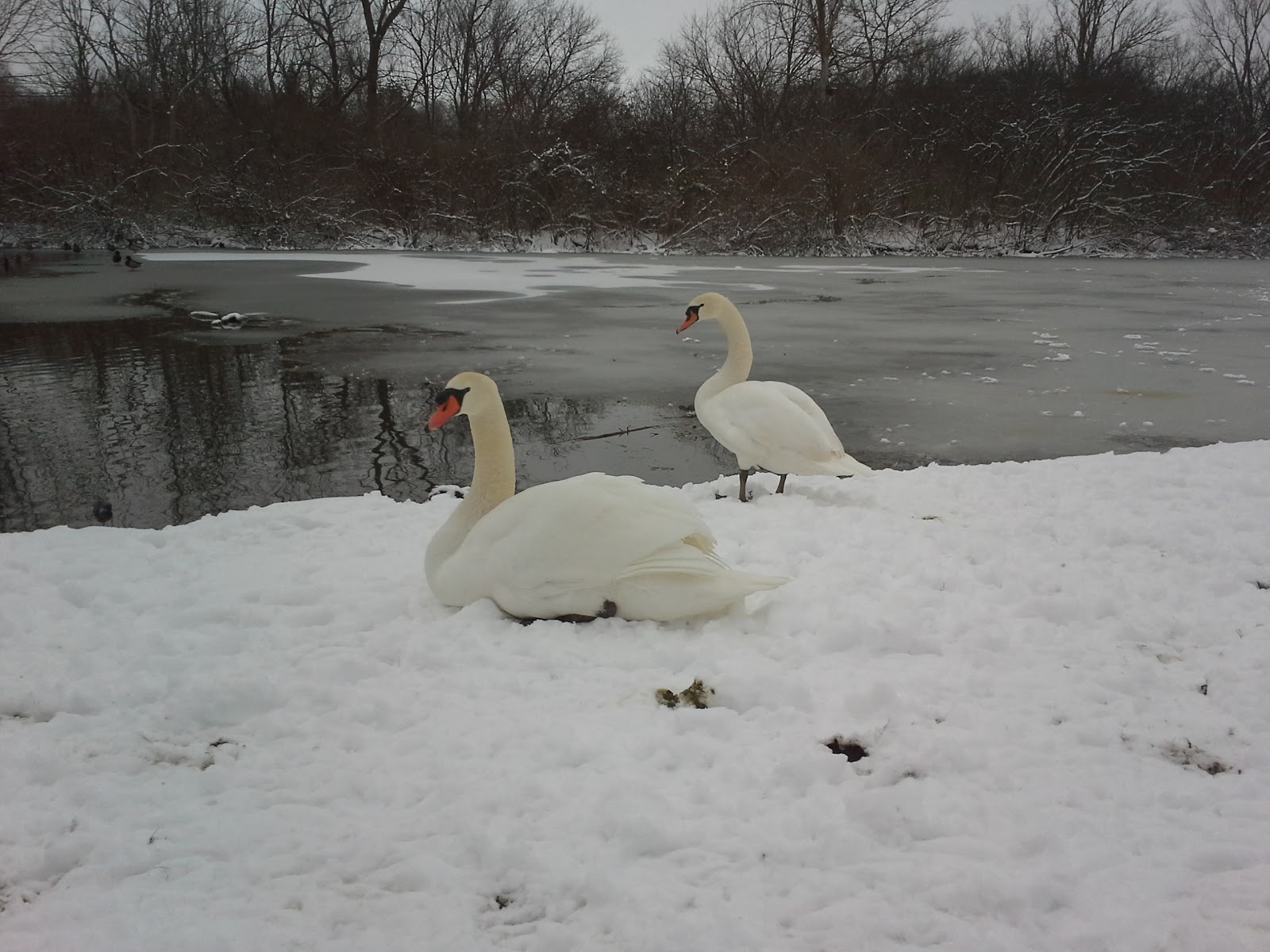
Of a September sunrise, banks of lespedeza thunbergii drip bowers of pink pea blossoms over still water. A pair of white mute swans and their brood of adopted ducklings slumber on the lake shore, head under wing.
Four great blue heron ring the shore, perched equidistant on spindly leg. The moment I arrive, they take off in simultaneous prehistoric flight, rising on teradactyl wing into the misty vapor burning off toward the sun.
September's fleeting perfection. These goldenrod days.
But as the poet observed, nothing gold can stay.
This first day of October, our big male mute swan glides the lake slowly, emitting a plaintive wail.
The old folklore has it that the mute swan, Cygnus olor is silent its entire life, until at death it emits just one exquisite song: the distilled essence of a placid regal life.
I know nothing of this folkloric final song, but the Cygnus olor I have come to know are not mute. This spring, for example, our female swan honked plaintively, mourning shattered eggs she lovingly tended on her floating twiggy throne.
This first day of October, it is Giuseppe, our fierce male, who glides the lake emitting the saddest possible song.
This weekend his lifelong mate Gina dipped her long graceful neck below water for the last time.
Her buoyant corpse greets us this first October morning. Her mate for life circles the lake mournfully. Together, as a pair, each ensuing season they hone their skill, ferociously guarding their territory, warding off predators, defending their eggs in tandem.
Now she rests on these old Canton acres. We buried her beneath an arborvitae tree.
It seems wrong, somehow, she, a creature of grace and of water, moored to this pebbly ground.
The old timers say, the sudden arrival of a wild swan on your lake brings incredible luck.
And so this spring began, on this very pond. A perfect crystal morning. A great swooping of white wings. And then, suddenly, placidly gliding on the water, a new young male swan, a feisty cob, in the center of the lake.
Displays of strength ensue, as our old male swan with a bum foot fends off a potential rival. His pen swimming prettily, weighing her options.
Onto the ground the rival cobs toddle, an awkward charge through vineyard rows.
And suddenly of a bright spring morning, the intruder swan is gone, as quickly as he arrived, as if a phantasm, as if a fever dream.
Their idyl restored, our resident pair glide the lake once more in tandem: circles, pirouettes, a mirror reflection of elegant necks joined as a heart.
The tender chivalry of these blinding white birds, he placing bits of scratch feed below water for her to gracefully retrieve. She so gentle in the tending of her nest, a regal throne on which she enshrined herself for many lean months, on brittle eggs that never hatch, reaching to scrape sustenance from those low branches her long neck could reach.
The mutability of the swan.
Good fortune and the arrival of luck in spring.
Death and lament in autumn.
I know nothing of the fabled swan song, the mythic melody that arrives only just before the moment of death.
But this I know, these swans are not mute.
Twice this year I heard swans cry.
She, in April, over shattered eggs she lovingly tended.
He, in October, in lament for his mate, probably weakened, tending her eggs far too long after they should have hatched.
And so autumn ends in Canton, after a perfect golden September, a perfect sunrise moment that of course cannot stay.
Atop his head, perched askew, something that looks like an English barrister's wig. Slung over each shoulder, a canvas Akron Beacon Journal newspaper carrier bag. Each bag is stuffed full of plush animals.
Guy in an English barrister's wig inquires about a pay phone.
Discussion ensues: Used to be one at the Sparkle Market. Maybe Taylor Library? Used to be one at the Sohio station but that's torn down now.
Several cellular devices are proffered.
Guy in an English barrister's wig exits bar.
You know that guy?
Nah. Thought you did.
Nope.
Wonder what was up with the paperboy bags?
And then discussion returns to the Indians' abysmal summer.
Not a word about the barrister's wig. Or the stuffed animals. Or the anachronistic request for a payphone.
Some recent local event had folks blathering about my old hometown. Generalizations: this was a retrograde place. Full of close-minded, ignorant, intolerant types.
I mentioned that although I rarely visit these interweb forums, and had only briefly skimmed the electronic rants that had folks atwitter, my experience out and about in this town where the river twists and drops extravagantly had always been that this is a place with a rather high incidence of, and tolerance for, eccentricity.
In fact, to me, it's the sort of place that almost seems to celebrate it.
This is a town where the beloved Grand Marshal of our 175th Anniversary parade was an octogenerian in a gold lame´ jumpsuit who tap danced part of the way down Broad Boulevard.
This is the kind of place, where, two nights after encountering the guy in an English barrister wig, in the very same block, in the middle of a busy downtown festival, a man in a filthy plush chicken suit plays the accordion. A few polite quarters are tossed in his case. Otherwise, nary an eyebrow is raised.
This is a city where generations of children recited Christmas wishes to a giant, angry, armless snowman, with flashing red eyes.
This is a city loomed over by a giant concrete Tower To Nowhere, unfinished for decades, perched behind a round Cathedral of Tomorrow, just blocks from a circular windowless office building, which was next to the junior high school, and shrouded with sand-cast concrete sculptures of naked ladies dancing.
In short, this is the sort of town that ends up giving the world DEVO.
I think our penchant to accept eccentricity, to think nothing of a guy walking in to a bar on a fine summer evening with a barrister's wig askew atop his head, has something to do with this being the kind of place where we've always kept close quarters.
Back when mills burgeoned along the raging river, this was a boomtown where everyone clustered in about six city blocks on either side of the waterfall.
After that, vast farms stretched to the mire of Northampton, so if you lived on one of the town lots you were cheek to jowl with your neighbors.
Our next boom came after the War. Closely set, basement-less Heslop homes filled the farmland, and classes of 900 or more graduated from the only place that could hold everyone, the enormous Cathedral of Tomorrow with its cross of ever-changing Technicolor, suspended magically from the ceiling.
No matter what you thought of your neighbor, more likely than not a thin asphalt driveway is all that separated your castle from his.
So many eccentric neighbors.
There was Ernie, rumored to be a millionaire, who lived in a tall ramshackle house next to Laconi's Pizza (where, for some reason, pickled green peppers were listed as "mangos" on the menu.) His wife kept pigeons in hutches, and swept the dirt yard clean with a broom every day.
Ernie made his rounds religiously each week, pulling a wagon atop which he had constructed an oversize wooden box. People would set out for him newspapers, cardboard, anything metal. Ernie had a day he hit each street, and the night before, residents left their items for him on the devil strip.
Ernie's shoes never had laces, and he always stomped the heels flat. He was a big man, with gray whiskers, and pants hitched up to his chest and belted with rope. He had a distinctive shuffle, making his way down gravel and tar side streets bounded by deep ditches and towering silver maples lined up in rows along the devil strip.
Rival corner groceries hunkered on either corner of Grant and Meriline Streets, tended by cantankerous proprietresses. If Mrs. Patrick saw you so much as darken the door of Mrs. Jones's place across the corner, she would scold you and forbid you from buying anything from her for a week. (Even if the only reason you went to Mrs. Jones was because Mrs. Patrick was out of milk that day.)
In the same block, The Red Haired Lady and The Black Haired Lady lived in small cottages next door to each other, and hated each other's guts. Nevertheless, each night they met on the sidewalk and walked together, noisily arguing, until one peeled off to the Boulevard Tavern and one went next door to the Chestnut Beer Garden. (Each had been banned from the other bar.)
There was Kenny, who rode a bike with flag-bedecked handlebars in every parade. He had a special badge and uniform. We all knew he wasn't a real cop but if there was a fender bender he was often first on the scene, directing traffic until the real patrolmen arrived.
It comes from living in close proximity. You overlook th foibles of your neighbor. You sit on your porch, you hear Ernie's shuffle, and his wagon wheels churning over gravel. You wave a greeting and he grumbles a reply. You never have a conversation, but you break up your old screen door before you put it out on the devil strip, so it will better fit in his wagon.
These were days of walking to corner stores, of open windows, of mothers standing on back stoops and hollering kids in to dinner.
I see my octogenerian neighbors hanging house dresses on the line, sitting on the porch, tending their yard on a fine summer night. I know them by face if not by name. Other houses are buttoned up and silent, but for the drone of air conditioning units.
Do the battened down people have any idea what a sweet honey of a summer night it is, with the season's first crickets? They might be on the interweb, spouting about the horrible town they live in, and the awful people who are their neighbors, who they never talk to and rarely see.
But some folks venture out. A hipster, a World War II Vet, a big guy with extended earlobes and rods through his brow sit at a bar.
A guy in an English barrister's wig and newspaper boy bags full of push toys asks about a payphone.
Each of them proffers his celly.
My Eccentric hometown. Shine on, America. Shine on, Cuyahoga Falls.